Disable Driver Signing Enforcement
Posted By admin On 24/09/19Sep 30, 2019 how do I disable driver signature enforcement win W10 preview? I need to install a sound card driver for my Creative X-Fi and the procedure doesn't seem to be nowhere identical to that of W8. Moved from Insider. The one we are looking for is “Disable driver signature enforcement”. To enable driver signature enforcement, use the below command and restart your system. Bcdedit /set nointegritychecks off Method 3 - Enable Test Signing Mode to Disable Driver Signature Enforcement. Alternatively, you can also enable test signing mode to disable driver signature and install unsigned drivers. This will disable your Windows 7 driver signing. I am still at work now and i want to try this on my personal computer at home, after i will post the answer if this is the solution or not, it seems that this modification is logical but i will test first.
- Disable Driver Signing Enforcement Windows 8.1
- Disable Device Driver Signing Enforcement
- Disable Driver Signing Enforcement Permanently
64-bit versions of Windows 10 and 8 include a “driver signature enforcement” feature. They’ll only load drivers that have been signed by Microsoft. To install less-than-official drivers, old unsigned drivers, or drivers you’re developing yourself, you’ll need to disable driver signature enforcement.
- Please check if you have performed these steps to disable the driver signature enforcement in Windows 10 Technical Preview. Press the Win + C and click on PC settings. Switch over to the “Update & recovery” section. Then click on the Recovery option on the left hand side.
- HOW TO PERMANENTLY DISABLE DRIVER SIGNATURE ENFORCEMENT IN WINDOWS 10. Procedure to permanently disable driver signature enforcement in windows 10 is quite similar to that of windows 8 and 8.1, but totally different from that of windows 7.
With Windows 10’s Anniversary Update, Microsoft tightened the screws even further. But you can avoid the more restrictive driver-signing requirements by disabling Secure Boot.
Driver Signature Enforcement Is a Security Feature
RELATED:What’s New in Windows 10’s Anniversary Update
Before you begin, keep in mind: Microsoft isn’t just trying to make your life harder here. Driver signing enforcement ensures that only drivers that have been sent to Microsoft for signing will load into the Windows kernel. This prevents malware from burrowing its way into the Windows kernel.
Disable driver signing and you’ll be able to install drivers that weren’t officially signed. Be sure you know what you’re doing! You should only install drivers you trust. Add monster manual 1977 in hindi.
Disable Driver Signing Enforcement Windows 8.1
Option One: Enable Test Signing Mode
Windows includes a “Test Mode” or “Test Signing” Mode feature. Enable this mode and driver signature enforcement will be disabled until you choose to leave Test Mode. You’ll see a “Test Mode” watermark appear at the bottom right corner of your desktop near your clock, informing you that Test Mode is enabled.
You’ll need to run a command from an Administrator Command Prompt to do this. To launch one, right-click the Start button or press Windows+X and select “Command Prompt (Admin)”.
Paste the following command into the Command Prompt window and press Enter:
RELATED:How Secure Boot Works on Windows 8 and 10, and What It Means for Linux
If you see a message saying the value is “protected by Secure Boot policy”, that means Secure Boot is enabled in your computer’s UEFI firmware. You’ll need to disable Secure Boot in your computer’s UEFI firmware (also known as its BIOS) to enable test signing mode.
Disable Device Driver Signing Enforcement
Restart your computer to enter test mode. You’ll see the “Test Mode” watermark appear at the bottom right corner of your desktop and you’ll be free to install whatever unsigned drivers you want.
To leave test mode, open a Command Prompt window as Administrator once again and run the following command:
Option Two: Use an Advanced Boot Option
RELATED:Three Ways to Access the Windows 8 or 10 Boot Options Menu
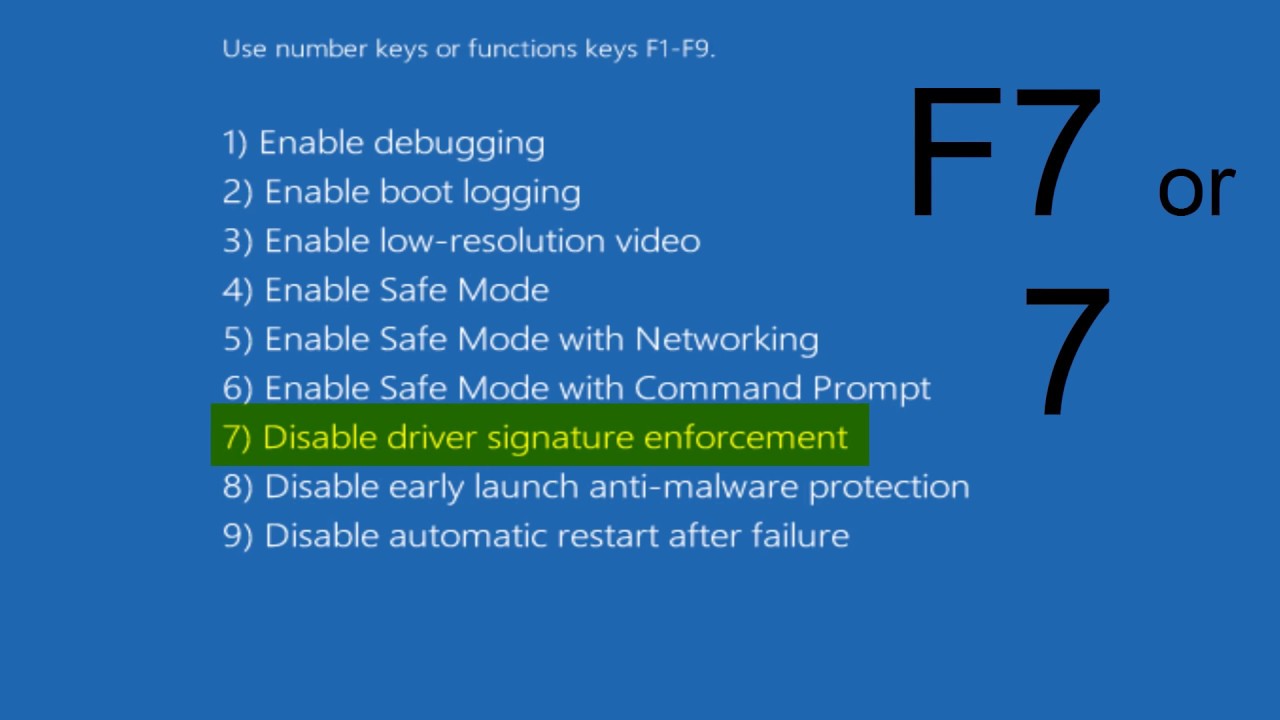
There’s also another way to do this. You can use the advanced boot options menu to boot Windows 10 with driver signature enforcement disabled. This isn’t a permanent configuration change. The next time you restart Windows, it will boot with driver signature enforcement enabled—unless you go through this menu again.
To do this, get to the Windows 8 or 10 advanced boot options menu. For example, you can hold down the Shift key while you click the “Restart” option in Windows. Your computer will restart into the menu.
Select the “Troubleshoot” tile on the Choose an option screen that appears.
Select “Advanced options”.
Click the “Startup Settings” tile.
Click the “Restart” button to restart your PC into the Startup Settings screen.
Type “7” or “F7” at the Startup Settings screen to activate the “Disable driver signature enforcement” option.
Your PC will boot with driver signature enforcement disabled and you’ll be able to install unsigned drivers. However, the next time you restart your computer, driver signature enforcement will be disabled—unless you go through this menu again. You’re now free to install drivers that haven’t been officially signed by Microsoft.
READ NEXTDisable Driver Signing Enforcement Permanently
- › Confirmed: Windows 10 Setup Now Prevents Local Account Creation
- › How to Disable the Apple Watch’s Always-On Display
- › How to Back Up Your Stuff and Switch to a New Mac
- › Is the Mac Pro Overpriced Compared to a PC?
- › Just Bought a Mac? 14 Essential Apps You Should Install